Insight
In healthcare, AI scales capability but leaders scale belief
AI is transforming healthcare. But the biggest barrier isn’t technology, it’s organizational capacity. Leaders from Piedmont Health and Chartis share why successful AI adoption is less about finding the perfect tool and more about creating the conditions for enterprise-wide transformation to stick.

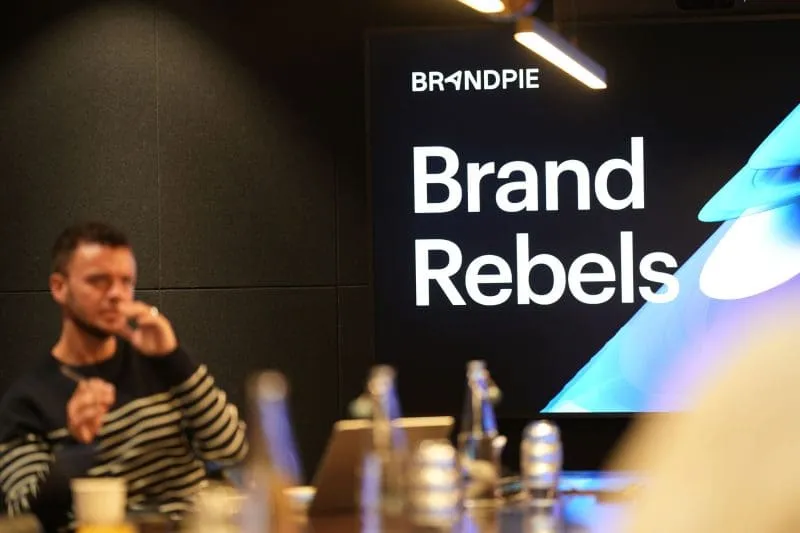
“Everyone is staffed and time is allocated to doing everything but this new work. It takes a heroic effort,” said Dr. Lacy Knight, System VP and Chief Health Informatics Officer at Piedmont Health during a recent Brandpie healthcare webinar, Healthcare at an inflection point.
Healthcare doesn’t lack interest in AI. It lacks slack capacity: time, attention, and bandwidth.
That’s what came through most clearly in our conversation with Dr. Knight and Sara Vaezy, Chief Product and Technology Officer at Chartis. Vendors and features multiply weekly and there are AI solutions for everything from efficiency to innovation to patient experience.
But the constraint isn’t imagination. It’s what it takes to turn capability into reality: leadership focus, the willingness to absorb near-term friction, and an organization that can test, learn, and scale without exhausting itself.
When AI transformation works, it’s rarely because an organization found the perfect tool. It’s because leadership treated AI as an enterprise mission and created the conditions for adoption to stick. When it fails, it’s usually quieter: a handful of pilots, a few workflow improvements, some early adoption, and then a plateau. Progress becomes expensive without becoming transformative.
Everyone is staffed and time is allocated to doing everything but this new work. It takes a heroic effort
Dr. Lacy Knight System VP and Chief Health Informatics Officer, Piedmont Health
This is not a technology rollout. It’s an enterprise imperative
“[AI] is an organizational transformation, and without the CEO being not just bought in, but driving it, it’s doomed to fail,” warned Sara Vaezy.
In healthcare, meaningful change competes with a long list of other priorities: clinical, operational, financial, regulatory. AI does not arrive into a vacuum. It arrives into a system already running hot.
That’s why the CEO and executive leadership matters. Not because the CEO needs to choose models or vendors, but because someone has to establish the agenda: what AI is for here, what success means in year one, where the organization will focus first, and what it will take to make progress believable.
If AI remains as a “tech experiment”, it will behave like an experiment: siloed, under-resourced, and fragile. If AI becomes an enterprise imperative, it gains what it needs most: shared direction that helps teams endure short-term friction for long-term value.
A simple diagnostic is worth asking: if you asked ten leaders what AI is for in your organization, would you get one answer, or ten?
You don’t get the future without change
“You cannot take advantage of these tools without changing something,” said Dr. Lacy Knight.
AI is often pitched as a way to reduce burden. Yet the path to that future requires adding burden first: integration, testing, workflow design, training, governance, measurement, iteration. That’s the “heroic effort” Dr. Knight described.
[AI] is an organizational transformation, and without the CEO being not just bought in, but driving it, it’s doomed to fail.
Sara Vaezy Chief Product and Technology Officer, Chartis
This is where organizations often underestimate the transformation. The limiting factor isn’t whether AI can help. It’s whether the organization can make room to find out.
A useful gut-check for leaders is simple: do you know where your organization is most ready for change, and where it is least ready? Do you understand why adoption is happening where it is (or isn’t)?
Readiness isn’t evenly distributed. It shows up in pockets: a unit leader with the right mindset, a department with a strong improvement culture, an operations team desperate for relief. The job of leadership is to identify those pockets, learn from them, and then scale what works.
Healthcare wants perfection. AI requires learning
“We are oriented to be perfect,” explained Dr. Lacy Knight.
Healthcare culture is built on rigor, safety, and reliability. That’s a strength. It’s also why AI adoption can be hard. These tools require iteration and feedback. They improve over time. That demands an organization that can tolerate controlled ambiguity: test, learn, refine, and keep going.
Dr. Knight made an important distinction: health systems already have continuous improvement cultures, especially around quality. The opportunity is to extend that mindset into AI adoption, not as reckless experimentation, but as disciplined learning with guardrails.
If organizations ask perfectionists to test imperfect tools without time, support, or clarity, the outcome is predictable: resistance, fatigue, and quiet failure.
The opportunity is enormous if the story is coherent
Of implementing AI, Dr. Lacy Knight said “I find it to be the most exciting and the most frightening thing I’ve ever done.”
AI can improve access, reduce administrative burden, strengthen decision-making, and unlock capacity in a workforce-constrained industry. But the organizations that succeed won’t just have more tools. They’ll have more alignment. They’ll be able to answer, clearly and consistently: what is AI for here, where will we focus first, what counts as value in year one, and what has to change for adoption to stick.
I find it to be the most exciting and the most frightening thing I’ve ever done.
Dr. Lacy Knight System VP and Chief Health Informatics Officer, Piedmont Health
And they’ll have a story people can repeat: the board, leaders, operators, clinicians, everyone pulling in the same direction.
A pivotal moment for healthcare
AI offers real potential to improve a stressed system, but only if the work is led and aligned.
Brandpie helps organizations turn AI from scattered pilots into a clear enterprise agenda by aligning leaders on ambition, focus, and a narrative people can act on. And because alignment can’t be assumed, we use collaborative tools, such as VYTALS (our anonymous online focus-group platform), to surface what’s true inside the organization: where readiness is highest, where resistance is likely, and what language builds confidence.
AI may be moving fast, but transformation is still human work.

About the author: Jason Hutt, Head of Strategy and Healthcare Lead
Jason has over 20 years experience combining insight and creativity to craft compelling brand strategies that drive growth and inspire audiences across healthcare.
Share this page