- News
Brand Strategy Built to Win Asia

When Uber sold its Southeast Asian business to Grab in 2018 in exchange for a stake in the combined company, most read it as a story about capital and competition. Uber agreed to sell its business in Southeast Asia to Singapore-based regional rival Grab, acquiring a 27.5% stake in Grab in return.
Look closer, though, and the real story is about positioning. Grab had entered the region earlier, built localized versions of its app, and partnered with local taxi fleets to quickly expand its fleet, while Uber ran a largely global playbook. Capital did not close that gap. Local trust did.
That is what a brand strategy is built to solve, and it rarely shows up in a logo.
Key takeaways
- A brand strategy is a commercial framework, not a visual identity system. Logos and color palettes are outputs, not the strategy itself.
- Being successful in Asia requires rebuilding positioning, tone, and proof points around local buyer behavior.
- The strongest brand strategies share five components: vision, market positioning, audience mapping, brand architecture, and a governance model that keeps everything consistent as the business scales.
- Brands with clear, consistent positioning across markets tend to outperform less-focused competitors on commercial metrics such as pricing power and customer retention.
What a brand strategy actually is
A brand strategy is the long-term commercial plan that defines why a business exists, who it serves, and where it stands relative to competitors.
It sits upstream of marketing, campaigns, and creative work. Get it wrong, and every downstream activity, from ad copy to trade show booths, ends up working against itself.
Most guides fall short because they treat brand strategy as a design exercise: pick a logo, choose a color, write a tagline.
In reality, strong corporate brand strategy development is a business exercise first and foremost. It forces leadership to agree on trade-offs before a single visual asset is created.
The five components a brand strategy must contain
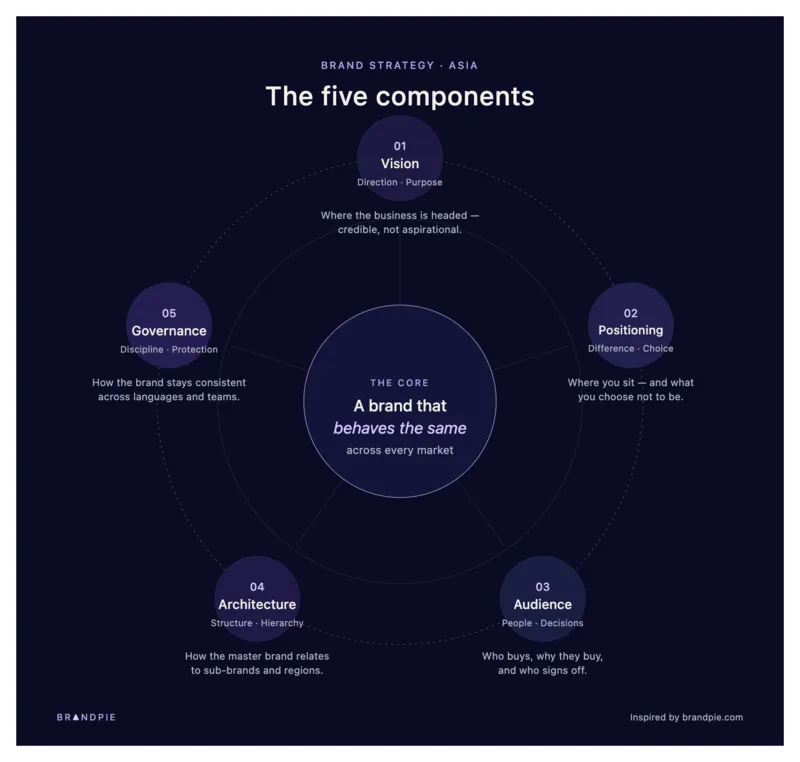
Each of these needs to be resolved and written down before naming, visual identity, or messaging work begins.
Skipping straight to design is the single most common reason rebrands fail to move the needle commercially.
Why a generic strategy will not win in Asia
Southeast Asia’s digital economy reached USD 263 billion in 2024, growing 15% year on year, and Asia is projected to account for two-thirds of the global middle class by 2030.
That scale is the opportunity. It is also the trap.
Treating Asia as one market is a common and costly mistake. A positioning statement that resonates in Singapore can fall flat in Jakarta or Bangkok, because purchasing behavior and trust signals vary by market.
Research into brand localization consistently finds that culturally resonant content, built with local creators in local formats, drives 30% to 50% higher engagement than direct ports of Western campaigns.
This is not only a tone issue. It shapes three things in particular:
Positioning language. A claim that reads as ambitious in London can read as arrogant in markets that prize humility in business communication.
Proof points. Case studies, credentials, and third-party validation carry more commercial weight in relationship-driven Asian markets than bold claims alone.
Visual and verbal consistency. Singapore’s multicultural, multilingual market rewards brands that maintain a coherent identity across languages, rather than fragmenting their message by channel.
A capable brand positioning consultancy builds this regional nuance into the strategy itself, rather than bolting it on after the global version is finished.
A practical blueprint for entering the Asian market
Before commissioning any creative work, a business expanding into Asia should be able to answer five questions:
- What is our category-defining idea, and does it still hold when translated into local business norms?
- Who exactly are we targeting in each priority market, and how does their buying process differ from our home market?
- What do we own that competitors cannot easily copy locally: relationships, credentials, category expertise, or something else?
- How will the brand flex across markets without fragmenting into inconsistent versions of itself?
- Who governs the brand once regional teams, agencies, and partners start producing their own content?
Answering these in order produces a strategy document that can genuinely guide decisions, rather than sit unread after launch.
Signs your brand strategy needs a rebuild
Before assuming a rebrand is needed, check for these warning signs first. They point to a strategy problem, not a design one.
- Sales and marketing describe the value proposition differently, even internally.
- Every new market requires messaging built from scratch, with no shared foundation.
- Competitors with a weaker product are winning more pitches.
- The brand looks consistent on paper, but regional teams quietly ignore the guidelines because they do not fit the local context.
Any one of these is a signal to revisit the strategy itself before touching the visual identity.
Clarity wins markets. Complexity loses them.
The businesses that succeed in Asia are rarely the best-funded ones. They are the ones whose vision, focus, and proof points hold together across every market they enter.
That clarity does not happen by accident. It is built, tested, and governed long before a single asset goes to design.
Successful businesses are the ones whose leadership teams made the hard positioning choices before they entered the market.
Working with an experienced global brand consultancy can shorten the distance between ambition and a strategy that survives contact with regional reality.
If your organization is preparing to enter or expand in Asia, speak to Brandpie about building a strategy that holds up on a market-by-market basis.
Share this page